
🤖 Robotics has just taken a leap that once seemed reserved for science fiction. A team of engineers at Northwestern University has developed a modular robot capable of rebuilding itself and continuing to function even after suffering severe damage, thanks to an approach that combines evolutionary artificial intelligence with a surprisingly simple physical design. This breakthrough redefines mechanical autonomy and opens the door to machines that are more resilient, adaptable, and useful in real‑world environments.
🧩 A “Metamachine” That Evolves and Adapts
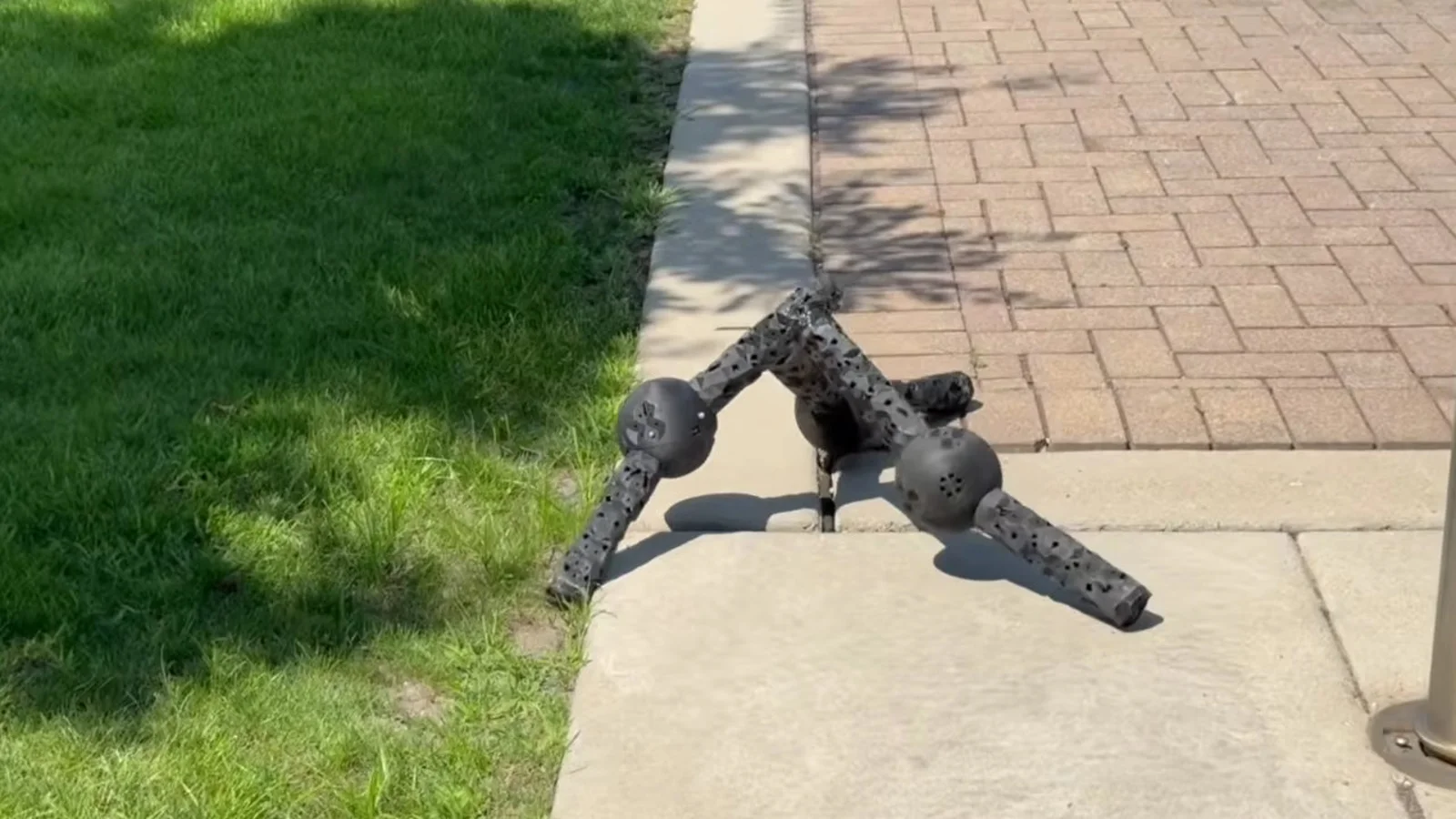
The project, published in PNAS, introduces a concept the researchers call “athletic intelligence”—robots that not only move, but survive. Each unit is an independent module shaped like a leg attached to a central sphere containing the battery, motor, and electronics. Even on their own, each module can roll, spin, and hop.
When several modules connect, something extraordinary happens:
- They reorganize themselves in real time.
- They adopt new shapes depending on the terrain.
- They function as legs, a spine, or even a tail.
- They maintain mobility even if a piece breaks off.
If the robot splits in half, the pieces don’t become useless—each one retains autonomy and can move independently to reunite with the rest of the body.
🧠 AI as the Architect of the Body
Instead of imitating known animals—a common approach that often limits creativity—the engineers allowed artificial intelligence to design the ideal body. They fed a simulator with principles from Darwinian evolution and let the algorithm generate, test, and discard thousands of configurations.
The result is a robot that:
- Moves smoothly over mud, sand, roots, and debris
- Flips itself upright if it falls
- Maintains mobility even after serious damage
- Reorganizes itself to keep moving
Sam Kriegman, the project lead, describes it as one of the first robots that “manages to step into the real world after evolving inside a computer.”
🌍 Real‑World Applications With Transformative Potential
The ability to self‑repair and adapt makes this technology ideal for environments where traditional robots fail easily:
- Search and rescue: operating in collapsed buildings, fires, or earthquake zones
- Space exploration: surviving impacts, extreme temperatures, and unpredictable terrain
- Industrial inspection: continuing to function despite drops, hits, or wear
- Agriculture and mining: adapting to irregular surfaces and changing conditions
- Modular and educational robotics: systems that evolve and reconfigure without human intervention
The key is not just that the robot repairs itself, but that it understands how to reorganize to keep fulfilling its mission.
🔧 A New Paradigm in Robotic Design
This breakthrough marks a profound shift in how robots are conceived:
- From rigid machines → to adaptive mechanical organisms
- From static designs → to bodies that evolve
- From robots requiring constant maintenance → to systems that self‑recover
The combination of simple modules, evolutionary AI, and physical autonomy creates an entirely new category: robots that don’t give up.
🧭 Conclusion
The metamachine developed at Northwestern is more than a striking experiment—it’s a preview of the future of robotics. Machines capable of adapting, surviving, and rebuilding themselves will change how we interact with technology and expand the limits of what robots can achieve in the real world.
Hello! I know this is somewhat off topic but I was wondering which blog platform
are you using for this site? I’m getting sick and tired of WordPress
because I’ve had issues with hackers and I’m looking at options for another platform.
I would be fantastic if you could point me in the direction of a good platform.
You can definitely keep using WordPress; the key is strengthening your security. A combination that works very well is installing Wordfence for attack protection and adding Google reCAPTCHA to block bots and automated access. With those two tools, most hacking attempts get stopped before they can cause any damage.
Also, WordPress is still one of the most flexible platforms with great support, so it’s worth optimizing it before moving to another solution.